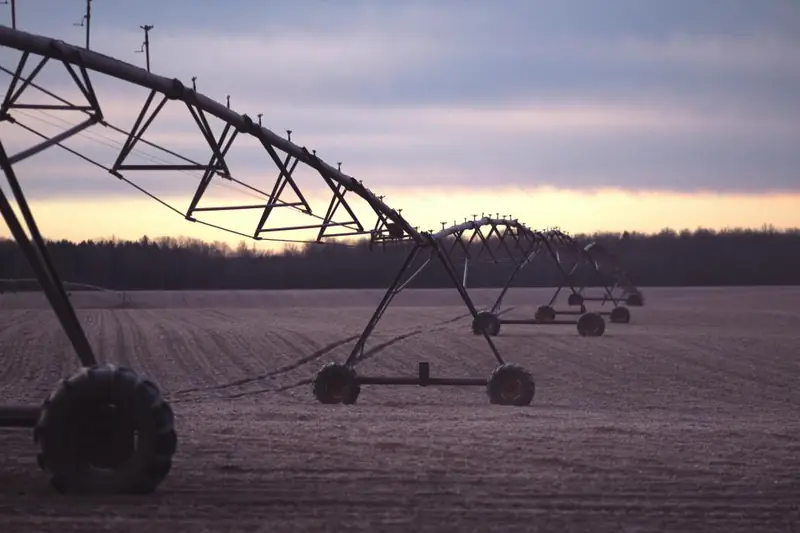
Fertigation: feeding crops through the drip line without clogging it or polluting the well
Photo: stocksnap (CC0, credits)
A drip system puts water exactly where the roots are. Fertigation uses the same pipes to put the nutrients there too, in small doses through the season instead of a few large spreadings. Done well, it is one of the most efficient ways to feed a crop. Done carelessly, it blocks emitters, spoils the uniformity of the system and can send fertiliser back into the well. This guide walks through the equipment, the chemistry and the safety rules, for growers planning next season during the winter break.
Why feed through the water
Fertigation is the application of plant nutrients through an irrigation system. The University of Georgia Extension's bulletin on drip chemigation describes it as “the timely application of small amounts of fertilizer through drip tubes directly to the root zone”, and reports that comparable or better yields and quality can be produced with 20 to 50 percent less fertiliser than with conventional ground application. The gain comes from timing and placement: nitrogen and potassium arrive when the crop takes them up, in the wetted volume where the active roots are, rather than being spread once on the whole field and partly lost before the plants need them.
The same bulletin is just as clear about the condition: fertigation is only as good as the drip system. Fertiliser follows the water, so a field where some emitters deliver more than others is also fed unevenly. Checking drip irrigation uniformity before the first injection is part of the job.
Three ways to inject
FAO's handbook on pressurized irrigation techniques (2007, chapter 3) describes the three main families of fertiliser injectors installed at the head of the system:
| Injector | How it works | Strengths and limits |
|---|---|---|
| Closed fertiliser tank | A pressurised tank on a bypass; a partly closed valve on the main line pushes part of the flow through it | Cheap and simple, but the dose is not constant: the solution is concentrated at the start and very dilute at the end |
| Venturi injector | A constriction on a bypass creates suction that draws the solution from an open container | Inexpensive, no moving parts; the injection rate is sensitive to pressure variations and the friction loss is about 1 bar |
| Piston (hydraulic) pump | Driven by the water pressure of the system, installed on the supply line | Constant injection rate, adjustable; more expensive than a Venturi |
Electric diaphragm or piston pumps complete the range on larger farms. The choice depends less on the crop than on how precisely the dose must be controlled. A closed tank suits a few bulk applications; frequent, proportional feeding needs an injector that keeps the concentration constant whatever the flow.
What goes into the tank
Only fully soluble products belong in a drip system. Most nitrogen and potassium sources dissolve well: nitrogen solutions, ammonium nitrate, calcium nitrate, potassium nitrate, potassium chloride. Phosphorus and sulphur need more care. The Georgia bulletin warns that they can react with calcium and magnesium in the irrigation water and form precipitates that clog emitters; micronutrients, if they must be injected, should be in chelated form.
Three practical points avoid most problems in the stock tank:
- Know the water. Hard water rich in calcium and bicarbonate, or water containing iron, is the usual source of scale. The interpretation of a laboratory analysis follows FAO Irrigation and Drainage Paper 29, Water quality for agriculture; our article on salty irrigation water explains how to read its main lines. Fertiliser salts also add to the salinity of the water the roots receive.
- Respect solubility. Some fertilisers cool the water as they dissolve; potassium nitrate is the classic example. Warm water speeds up dissolving, but dissolving more than the cold solution can hold is a mistake: the excess comes back out of solution as it cools and ends up in the emitters.
- Do not mix blindly. Calcium products and phosphates or sulphates in the same tank form insoluble deposits. When two products must be combined, a small test in a jar, at the dilution used, shows whether a precipitate forms. This is why fertigation set-ups often keep calcium products and phosphates or sulphates in separate tanks.
Sediments left in the tank should not reach the lines: the pump intake is set above the deposit, and a drain valve at the bottom allows the tank to be cleaned after each batch.
Keeping emitters open
Emitter outlets are small, and three things block them: mineral scale, algae and bacterial slime, and particles that get past the filters. The standard maintenance tools are filtration, acid and chlorine. The Georgia bulletin describes two acid strategies. Scale forms more readily above pH 7, so a small continuous injection can keep the water just below pH 7 whenever the system runs. Alternatively, deposits can be removed periodically by injecting enough acid for 45 to 60 minutes to bring the water down to pH 4 or 5, leaving it in the lines for several hours, then flushing laterals one after the other at full pressure. Chlorine controls algae and bacteria. Both operations involve hazardous chemicals: the product label, protective equipment and the order of mixing (acid into water, never the reverse) are not optional.
A sensible routine is to irrigate with clean water for a while before and after each fertigation, so that the system fills evenly before the nutrients arrive and the lines do not stand full of fertiliser solution between irrigations.
Protecting the water source
An irrigation system connected to a well or a mains supply can siphon its contents backwards when the pump stops. With a fertiliser tank on the line, that means nitrate or acid in the source water. Utah State University's chemigation guide calls backflow prevention “one of the most important safety components of chemigation systems”. The usual set-up combines a check valve and a vacuum relief valve between the pump discharge and the injection point, and an interlock that stops the injection pump whenever the irrigation pump stops, so the tank cannot empty into idle lines. Local rules on approved devices vary from one country or region to another and should be checked with the water authority.
Nitrogen rules still apply
Fertigation changes how nitrogen is applied, not how much the law allows. In the European Union, the Nitrates Directive (91/676/EEC) requires member states to designate nitrate vulnerable zones where waters exceed or risk exceeding 50 mg of nitrate per litre. As the European Commission summarises, fertilisation in those zones must be limited to crop demand and the nitrogen available in the soil, livestock manure is capped at 170 kg of nitrogen per hectare per year, and national action programmes set periods and places where spreading is banned. Fertigation makes it easier to stay within those limits, because the dose can be split and adjusted, but only if the grower keeps records of what was injected and when.
What FIGARO looked at
Nutrients were part of the FIGARO project from the start. Aarhus University ran a two-year precision fertigation experiment on potatoes at the Danish site, later used in the project's demonstrations, and C-Tech Innovation worked on a water quality and fertiliser sensor among the monitoring technologies (see the consortium page). One outcome is a paper by Z. Zhou, M. N. Andersen and F. Plauborg in the European Journal of Agronomy (2016, vol. 81, pp. 129–137) on how different nitrogen fertigation and irrigation regimes affected radiation interception and radiation use efficiency of potato. The underlying idea was the same as for water: measure what the crop and the soil actually do, with tools such as soil moisture sensors, and adjust the dose to it, rather than follow a fixed calendar.
A short checklist
- Check emitter uniformity and filters before the season.
- Get a water analysis; plan acid treatment if the water is hard or contains iron.
- Use fully soluble fertilisers; test any mixture in a jar first.
- Install and test backflow protection and the pump interlock.
- Run clean water before and after each injection; flush laterals regularly.
- Record every injection: product, quantity, date, field.
Sources
- Harrison K. A., Granberry D. M., Coolong T., Kelley W. T., University of Georgia Cooperative Extension, Drip Chemigation: Injecting Fertilizer, Acid and Chlorine, Bulletin 1130, consulted 23 November 2026.
- Phocaides A. (2007), Handbook on pressurized irrigation techniques, chapter 3, Rome: FAO.
- Utah State University Extension, Chemigation guide, consulted 23 November 2026.
- Council Directive 91/676/EEC concerning the protection of waters against pollution caused by nitrates from agricultural sources, EUR-Lex; European Commission, Nitrates.
- Ayers R. S., Westcot D. W. (1985), Water quality for agriculture, FAO Irrigation and Drainage Paper 29 Rev. 1.
- Zhou Z., Andersen M. N., Plauborg F. (2016), “Radiation interception and radiation use efficiency of potato affected by different N fertigation and irrigation regimes”, European Journal of Agronomy 81: 129–137.