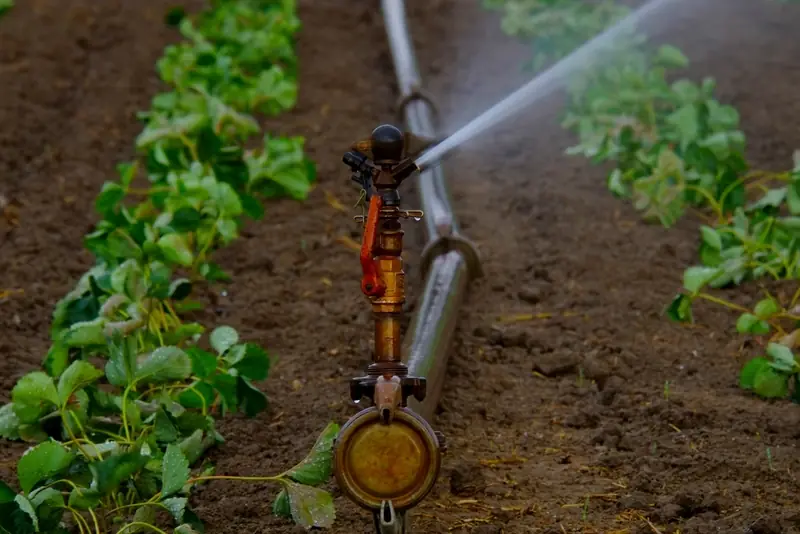
Walk along any drip-irrigated field and the pipe on the ground looks the same: a black polyethylene line with water appearing at regular intervals. Underneath that similarity are two different products. In an inline drip line, the emitters are built into the pipe at the factory, at a fixed spacing. With emitters on tubing, also called online or button emitters, the grower buys plain pipe and inserts each emitter where a plant needs it. The choice affects how evenly the water is spread, how the system clogs and how much labour it takes, long before any scheduling software comes into play.
How each is built
Inline drip line is extruded with the emitters already inside it. Toro's guide to emission devices describes dripline as tubing with emitters pre-inserted at specified intervals during manufacture, so installation is fast and nothing has to be fitted in the field. The same guide gives the drawback: the emitters sit where the factory put them, including places where no plant grows, and they cannot be taken out and serviced.
Online emitters work the other way round. The guide explains that they are attached to the tubing wall by pushing the emitter's barbed base through a punched hole. That lets the grower put an emitter exactly at each tree or vine, add a second one as the plant grows, and, with take-apart models, open and clean it. The price is labour: every emitter is fitted by hand, and a large planting may need many thousands.
Thin-walled drip tape, used for single-season vegetable crops, belongs to the inline family: the emitters are formed into its seam. It is covered in a separate article; this one deals with the heavier, multi-season drip line and tubing used in orchards, vineyards, nurseries, greenhouses and permanent vegetable beds.
Uniformity and clogging
The extension literature generally favours the inline design for performance. Penn State Extension's guide to drip irrigation for vegetable production notes that products with in-line or internally attached emitters tend to cost more but often have better water distribution uniformity and better resistance to clogging.
Two reasons explain it. Factory-fitted emitters are inserted with consistent spacing and bonding, so there are no badly seated buttons or punched holes that leak around the barb. And most modern inline emitters use long, turbulent-flow labyrinths and filters at the inlet that keep particles moving, which helps them resist the physical clogging described in our article on drip irrigation uniformity. Online emitters vary more in quality: good pressure-compensating buttons can match inline performance, cheap ones drift out of balance quickly. Neither design survives poor filtration, untreated hard water or careless fertigation.
Pressure compensation
A non-compensating emitter delivers more water when the pressure rises, so the flow falls along a long lateral or up a slope. Penn State explains that a pressure-compensating line keeps the same flow over a range of pressures, and gives the example of common, partially compensating lines whose flow increases by about 10 percent when pressure rises by 20 percent.
Both families exist in compensating and non-compensating versions. In practice, compensating inline drip line is the usual answer for long rows and hilly vineyards, because the compensation is built into every emitter along hundreds of metres. With online emitters, compensation lets a single pipe feed plants of different sizes, each with the emitter count it needs, on uneven ground. In either case the system still needs enough pressure at the far end of each lateral to stay within the compensating range, and some compensating designs include an anti-drain feature that keeps the line full between irrigations so that every emitter starts at the same time.
Side by side
| Criterion | Inline drip line | Emitters on tubing (online) |
|---|---|---|
| Emitter position | Fixed at the factory spacing | Chosen plant by plant in the field |
| Installation | Fast: unroll and connect | Slow: punch and insert every emitter |
| Uniformity and clogging | Usually better, according to extension guides | Depends heavily on emitter quality and fitting |
| Changing the layout | Limited; extra emitters can be added, existing ones not moved | Easy to add, move or plug emitters |
| Maintenance | Flush the lines; a failed emitter means cutting in a repair or replacing a length | Take-apart models can be opened and cleaned |
| Subsurface use | Possible: can be buried to keep the surface dry | Surface only; buttons snag and are easily damaged |
| Typical uses | Row crops, vineyards, high-density orchards, landscape beds | Widely spaced trees, nurseries, containers, mixed plantings |
Which one for which planting
Rows with regular spacing such as vines, high-density orchards, berries or permanent vegetable beds: inline drip line is almost always simpler and more even. The emitter spacing is chosen to match the soil, closer in sandy soils where water spreads little sideways and wider in clay, and to create a continuous wetted strip along the row.
Widely and irregularly spaced plants such as young or mixed orchards, hedges, ornamental plantings and pots: online emitters avoid watering bare ground between plants, and the number of emitters per plant can grow with the canopy. Some growers combine the two, with a looped inline line around large trees.
Buried systems: subsurface drip irrigation uses inline drip line, which can be placed below the surface so the soil stays dry and protected; Toro notes that this is the one emission device that can be installed this way. Buried lines need root-intrusion protection and air-vacuum valves, and their maintenance has to be planned from the start.
Cost over the life of the system
The purchase price per metre favours plain tubing, but the comparison is incomplete without labour and lifespan. A planting that needs four emitters per tree on irregular spacing may be cheaper with tubing and buttons; a vineyard with thousands of metres of identical rows almost certainly is not, once the hours of fitting are counted. Wall thickness and the expected life of the pipe matter as much as the emitter: a thicker multi-season line that lasts many years costs less per season than a cheaper one replaced early. For the energy side, our article on pumping energy shows how operating pressure feeds into the running cost.
Where FIGARO comes in
The FIGARO project was coordinated by Netafim, a drip irrigation manufacturer, and its pilot sites used drip and micro-irrigation on crops as different as cotton, potatoes, citrus, table grapes and maize (see the consortium page). The project's focus was not on hardware but on deciding when and how much to irrigate. The two questions are linked: precise scheduling only pays off if the drip system, whichever type it is, delivers the planned dose evenly to every plant.
A short checklist
- Match the emitter spacing and flow to the soil and the plant spacing before choosing a product.
- Choose pressure-compensating emitters for long runs, slopes or plants of different sizes on one line.
- Budget for filtration and flushing points, whatever the type of line.
- For online emitters, buy quality, use the correct punch and fit them all the same way.
- Check the flow of a sample of emitters each season, as described in our uniformity article.
Sources
- Penn State Extension, Drip Irrigation for Vegetable Production, consulted 26 November 2026.
- Toro, Drip Tips, Drip irrigation emitters and emission devices, consulted 26 November 2026.